Which of the Following Is a Characteristic of Modern Grandparenting Especially in Poor Families

The past five decades – spanning from the fourth dimension when the Silent Generation (today, in their 70s and 80s) was inbound adulthood to the adulthood of today's Millennials – take seen big shifts in U.S. order and civilisation. It has been a flow during which Americans, especially Millennials, have become more detached from major institutions such as political parties, organized religion, the war machine and marriage. At the same fourth dimension, the racial and ethnic brand-up of the state has changed, college attainment has spiked and women accept greatly increased their participation in the nation'south workforce.
Our new interactive graphic compares the generations today and in the years that each generation was young (ages 21 to 36) to demonstrate the sea change in young adults' activities and experiences that has occurred over the past 50 years.
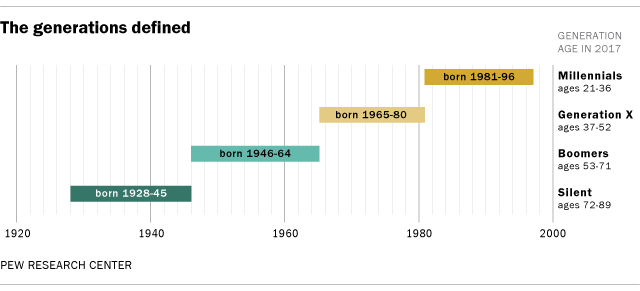
Our analysis finds several distinctive ways that Millennials stand out when compared with the Silent Generation, a grouping of Americans erstwhile enough to be grandparents to many Millennials:
i 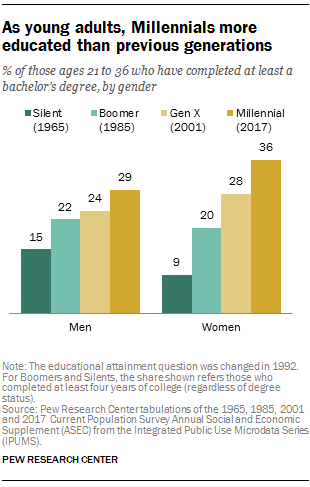 Today's young adults (Millennials ages 21 to 36 in 2017) are much meliorate educated than the Silent Generation. The educational trajectory of young women across the generations has been especially steep. Among Silent Generation women, only 9% had completed at to the lowest degree 4 years of college when they were young. By comparison, Millennial women are four times (36%) every bit probable as their Silent predecessors were to have at least a bachelor's caste at the aforementioned age. Educational gains are non limited to women, every bit Millennial men are besides ameliorate educated than earlier generations of young men. 3-in-x Millennial men (29%) have at least a bachelor'south caste, compared with 15% of their immature Silent counterparts. These higher levels of educational attainment at ages 21 to 36 propose that Millennials – especially Millennial women – are on runway to be our nearly educated generation by the fourth dimension they consummate their educational journeys.
2A greater share of Millennial women have a bachelor'due south degree than their male counterparts – a reversal from the Silent Generation. In the past half-century, growing shares of both men and women have earned a available's degree. However, women take fabricated bigger gains over the period. Among Millennials ages 21 to 36 in 2017, women are seven percentage points more likely than men to accept finished at least a bachelor's degree (36% vs. 29%). Back when Silents were ages 21 to 36, women were 6 points less likely than men to take finished at least four years of college didactics. Gen Xers were the first generation of women to outpace men in educational attainment, with a iii-percentage-point advantage among Gen Ten women ages 21 to 36. By comparison, the Babe Boom generation was the nigh contempo in which men were better educated than women, having a two-bespeak advantage over immature Boomer women.
3Young women today are much more likely to be working, compared with Silent Generation women during their young adult years. In 1965, when Silent women were young, a majority (58%) were not participating in the labor force and forty% were employed. Amid Millennials, that pattern has flipped. Today, 71% of young Millennial women are employed, while 26% are non in the labor forcefulness. This shift to more women in the workplace occurred as early as 1985, when Boomers were young. Then, nearly seven-in-ten young Boomer women (66%) were employed and 29% were not in the labor force.
4Millennials today are more than 3 times as likely to have never married as Silents were when they were immature. Almost six-in-x Millennials (57%) have never been married, reflecting broader societal shifts toward marriage later in life. In 1965, the typical American adult female first married at historic period 21 and the typical human wed at 23. By 2017, those figures climbed to 27 for women and 29.v for men. When members of the Silent Generation were the same age as Millennials are now, only 17% had never been married. Still, almost two-thirds of never-married Millennials (65%) say they would like to become married anytime. When asked the reasons they have non gotten married, 29% say they are not financially prepared, while 26% say they have not found someone who has the qualities they are looking for; an additional 26% say they are too young and not ready to settle down.
fiveMillennials are much more likely to be racial or ethnic minorities than were members of the Silent Generation. L years ago, America was less racially and ethnically various than it is today. Large-scale immigration from Asia and Latin America, the ascent of racial intermarriage and differences in fertility patterns across racial and ethnic groups accept contributed to Millennials being more racially and ethnically diverse than prior generations. In 2017, fewer than 6-in-10 Millennials (56%) were non-Hispanic whites, compared with more than eight-in-ten (84%) Silents. The share who are Hispanic is five times as large amid Millennials as among Silents (21% vs. 4%), and the share who are Asian has also increased. However, the share who are black has remained roughly the same.
sixImmature Silent men were more than x times more probable to be veterans than Millennial men are today.Although Millennials came of age at a time when the United States engaged in military conflicts in Iraq and Afghanistan subsequently the Sept. 11 terrorist attacks, they are far less likely to accept served in the military machine than their Boomer or Silent predecessors. Among men, but 4% of Millennials are veterans, compared with 47% of Silent men, many of whom came of age during the Korean State of war and its aftermath. The number of immature men serving in the active-duty military has decreased drastically since the establishment of an all-volunteer force in 1973, which is reflected in the decreased share who are veterans since so. Comparable historical data for veteran status by generation is not available for women, but opposite to men, the number of women serving in the active-duty armed services has risen in recent decades.
sevenGreater shares of Millennials today live in metropolitan areas than Silents or Boomers did when they were young. In 1965, when members of the Silent Generation were immature, two-thirds (67%) lived in a metropolitan area, while one-tertiary (33%) lived in not-metropolitan areas. And a similar share of Baby Boomers (68%) lived in metro areas when they were young. By comparing, more contempo generations are residing in metropolitan areas at higher rates. More than 8-in-x Gen Xers (84%) lived in metropolitan areas when they were immature and nigh 9-in-ten Millennials (88%) today alive in metro areas.
Note: This is an update of a post originally published on March 19, 2015.

Richard Fry is a senior researcher focusing on economics and education at Pew Research Eye.
Eileen Patten is a erstwhile inquiry analyst focusing on Hispanic, social and demographic trends at Pew Research Center.
henleycoundtowned.blogspot.com
Source: https://www.pewresearch.org/fact-tank/2018/03/16/how-millennials-compare-with-their-grandparents/
0 Response to "Which of the Following Is a Characteristic of Modern Grandparenting Especially in Poor Families"
Post a Comment